You know that scene in every crime thriller?
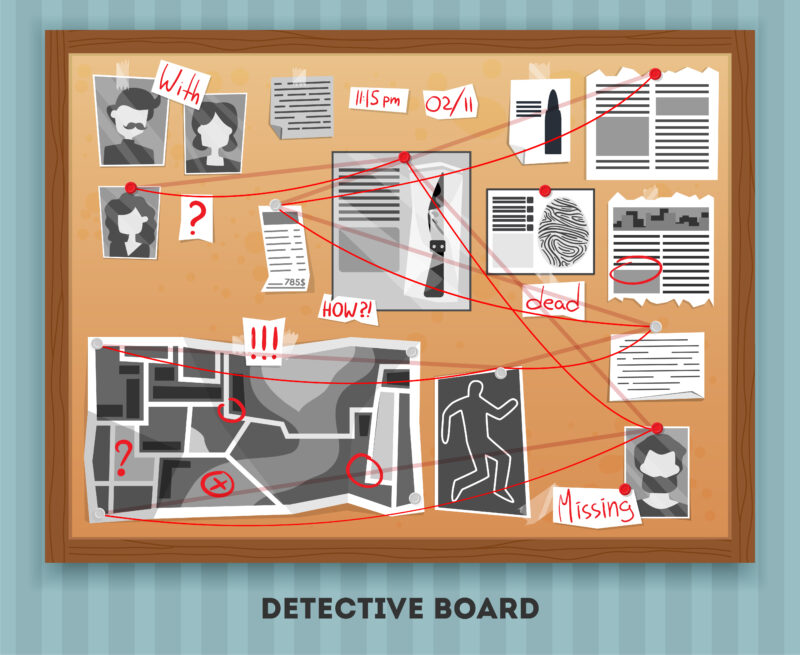
The detective is exhausted. He’s been chasing leads for weeks. He stands in front of a giant corkboard covered in photos, sticky notes and maps. But the chaos isn’t random. It’s connected by a web of red string.
He’s staring at it. Then he shifts back. And all at once, click.
He sees the missing link to the case and solves it.
But for you, here’s the harsh reality: you’ll never experience that “click” moment from looking at a linear to-do list.
Lists are great for grocery shopping, but they are terrible for thinking. When you write a list, you force your brain to march in a straight line. But your brain doesn’t work like a soldier; it works like that detective. It jumps, it connects, and it circles back.
If you’re finding it hard to write that blog post, plan that project, or solve that business crisis, the problem isn’t your ideas. The problem is your format.
Most guides will tell you mind mapping is like “drawing a tree“. That’s cute, but it’s too passive.
True mind mapping is the practice of creating an evidence board for your thoughts. It’s about taking the jumble inside your head, pinning it to the wall, and showing up in plain view the invisible red string that binds it all together.
Are you prepared to discover the groundbreaking idea concealed within your chaos?
Let’s get to work by understanding:
What Exactly Is a Mind Map?
A mind map is a visual diagram that begins with a central idea and then branches out into associated topics, subtopics, connections, and insights. It’s essentially a canvas to capture your thinking – everything you know about a subject, all in a single glance.
Instead of writing ideas in a straight line, you’re letting them radiate out from each other, branching, like branches growing off of a tree.
Why Your Brain Loves Mind Maps and Hates Lists (The Science)
Why does the “Detective Board” work better than a Word Doc?
It comes down to radiant vs. linear thinking.
Lists are linear. They force you to prioritise immediately (Item 1 comes before Item 2). This kills creativity because your brain enters “execution mode” before you have finished “thinking mode”.
Mind maps are radiant. They allow you to dump information without judging its order yet.
Consider this stat: According to 3M research, visuals are processed 60,000 times faster in the brain than text. When you map ideas visually, you aren’t just “organising”. You are hacking your brain’s bandwidth.
Best Tools for Mind Mapping
A quick, practical list based on use case:
For The Purist: Pen & Landscape Paper
Best for: The first 15 minutes of deep thinking. Nothing beats the speed of the hand-to-brain connection. There is no software lag to slow down your “Aha!” moment.
Constraint: Hard to edit later.
For those who want online mind map tools
- Whimsical.com – My favourite 1
- Mapify.so – My favourite 2
- Mymap.ai – My favourite 3
- MindMeister – Easiest for beginners
- Miro – Best for teams & collaboration
- XMind – Great for students
- Notion – Perfect if your writing already lives here
- Canva – Ideal for visually polished maps
- Obsidian – For deep thinkers and knowledge management
Also Read: 33+ Proven Techniques to Get Creative Ideas
The “Anti-Example”: Why Most Maps Fail
I want to save you hours of frustration.
The #1 reason people quit mind mapping is “The Wikipedia Trap“.
This happens when you try to map everything you know about a topic. You end up with a giant spiderweb that is impossible to read.
The Fix: Use the “Rule of 3 Levels”.
- Core Topic
- Main Arguments
- Supporting Data
If you need to go to a 4th level, that branch deserves its own separate map. Zoom out to zoom in.
The Napkin Challenge
You can read about push-ups all day, but you won’t get stronger until you drop and give me twenty.
Here is my challenge to you:
Do not download a new app yet. Grab a napkin or a piece of printer paper. Take the biggest problem stressing you out right now. Put it in the centre. Give yourself 60 seconds to branch out every possible cause and solution.
Find your red string.
Case closed.
FAQ: Quick Answers
Q: What is the main purpose of mind mapping?
A: The main purpose of mind mapping is to visualise relationships between ideas, allowing for “divergent thinking” (generating many solutions) rather than linear processing.
Q: Can mind mapping help with SEO content?
A: Yes. Writers use mind maps to visually group “semantic keywords” and ensure all topical gaps are covered before drafting an article.
Q: Who invented mind mapping?
A: While popularised by Tony Buzan in the 1970s, the concept of “branching diagrams” dates back to Porphyry of Tyros in the 3rd century. It is a timeless cognitive tool.